Jump rope for boxing: footwork and round-based workouts
Boxer skip, footwork drills and 3-minute rounds with a minute's rest: how boxers use the rope and three sessions you can run today.
Key points
- The boxer skip is the base rhythm for long rounds.
- Train in 3-minute rounds with 1-minute rest.
- Rotate footwork drills inside each round.
Boxers skip because it trains what the sport needs: light, rhythmic feet, shoulder endurance and the habit of working in timed rounds. You do not have to box to train like this.
Why it suits boxing
- Rhythm and bounce. Staying light on the balls of the feet is the base of boxing footwork.
- Rounds. Amateur and professional boxing use 3-minute rounds (with some amateur categories using shorter rounds); skipping in the same format builds the habit of pacing a round.
- Shoulders. Keeping the hands up and turning a rope for minutes is good endurance work for the arms.
The boxer skip
Shift your weight from one foot to the other on each turn, the other foot just touching the floor. It looks like a light rocking bounce. It is easier to sustain than two-foot bounces, which is why it is the default for long rounds. Learn it from the footwork guide.
Footwork drills to rotate through a round
- Boxer skip (base rhythm)
- Alternate step (running in place)
- Side-to-side: small hops left and right
- Forward and back: small hops in front of and behind a line
- High knees for 10–20 seconds
- Double unders or fast turns for short bursts, if you have them
Three boxing-style workouts
| Level | Session |
|---|---|
| New to rope | 4 rounds of 2 min (boxer skip, trip-ups allowed), 1 min rest |
| Comfortable | 5 × 3 min, 1 min rest. Each round: 2 min boxer skip, 30 s footwork drill, 30 s fast |
| Experienced | 6–8 × 3 min, 1 min rest. Last 30 s of every round at maximum speed or double unders |
Warm up first (the 5-minute warm-up) and set the timer to custom: work 180, rest 60.
Which rope?
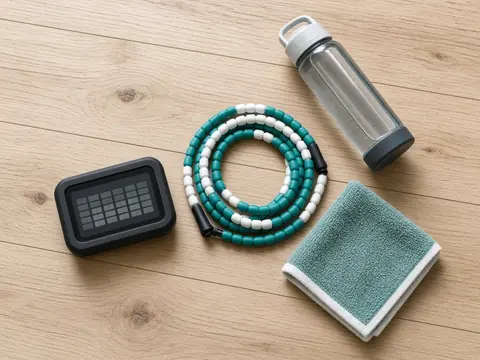
A light PVC or beaded rope is the usual choice for boxing-style footwork: fast enough for rhythm, visible, and forgiving. Heavier ropes build the shoulders but slow footwork down; see weighted ropes.
Common mistakes
- Hands drifting wide. Keep elbows close and turn from the wrists.
- Going flat out in round one. Pace it so the last round is as good as the first.
- Flat-footed landings. Stay on the balls of the feet throughout.