Jump rope knee pain: causes and fixes
Usually technique, surface or too much too soon. How to check each one, what to change, and when to stop and get help.
Key points
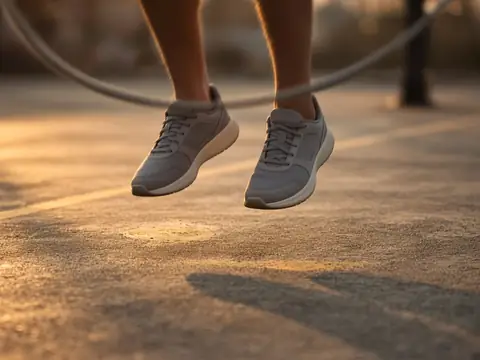
- Hop low, land soft on the balls of your feet, knees over toes.
- A mat or sprung floor and a correctly sized rope help.
- Swelling, locking or giving way: see a professional.
Skipping is often easier on the knees than running, because the hops are small and you land on the balls of your feet. When knees do hurt, the cause is usually something you can change: jumping too high, landing stiff-legged, a hard floor, or too much too soon.
This page is general information, not a diagnosis. Swelling, a knee that gives way, locking, or pain after a twist or fall needs a doctor or physiotherapist, not a technique tweak. The same goes for returning to skipping after a knee injury or surgery: follow your clinician's plan.
Common causes
| Cause | What it looks like | Fix |
|---|---|---|
| Jumping too high | Big hops, loud landings | Clear the rope by 2–3 cm only |
| Locked knees | Landing on straight legs | Keep a soft, slight bend on every landing |
| Heel landings | Thudding, jarring feel | Land on the balls of the feet, heels just above the floor |
| Knees caving in | Knees drift towards each other on landing | Feet hip-width; knees track over the toes |
| Hard surface | Concrete, tiles | Use a mat or a sprung floor (see best surfaces) |
| Sudden jump in volume | Pain after a new challenge or longer sessions | Back off, then add no more than 10–20% a week |
| Rope too short | You jump higher or tuck to clear it | Re-size the rope (see sizing) |
A quick technique check
- Film yourself from the side for 20 seconds.
- Check: small hop, soft knees, heels never slam down, upright posture.
- From the front: knees should point the same way as your toes on every landing.
The basics are in how to jump rope properly.
Strength that tends to help
Common supporting exercises for jumping athletes, done two or three times a week, are calf raises, split squats or step-ups, glute bridges and side-lying leg raises. Start easy; they should not hurt.
Lower-impact ways to keep training
- Alternate step (one foot at a time) instead of two-foot bounces: each landing is lighter.
- Ropeless skipping with very low hops on a mat.
- Cycling, rowing or swimming for conditioning on days the knees are grumpy.
Stop and get it checked if
- The knee swells, locks, clicks painfully or gives way.
- Pain is sharp, gets worse during the session, or lasts into the next day.
- It hurts at night or at rest.